It was only when the full-scale war began that I found out I was pregnant... I wanted to treat my child with the utmost care, but it was impossible to buy even the most basic medicine.
The russians were firing on civilians so that we couldn’t leave my hometown right away. I lived in a basement for almost a month, out of my mind, with fear and worry about the lives of both my husband and our little child. My husband works for the Ministry of Emergency Situations. When the russians targeted his unit, he insisted that I leave immediately, without grabbing our things and without any idea of what might happen next. My husband had a sister living in Kryvyi Rih, so we went to join her, but she was already sick with cancer. Two weeks later, she was gone. She died in my arms. I had to stay strong to take care of the baby in my belly. Another seven months passed, and I gave birth to Sofiia on 1/11/22 (She chose wonderful dates; her conception was on 02/02/2022).
I had a happy childhood, even though we were poor, but I don’t want the same for my child. When the war started in 2014, it was traumatising. Before that, I had no awareness of what war was, and I thought that we would be shot for making any sound. It was terrifying. I had to take care of my baby brother when he was only six weeks old and my disabled seven-year-old brother, who understood absolutely nothing about what was going on and could not defend himself. I often had to mentally prepare myself for death, covering my brother with my body during the shelling in 2014. Ten years later, I am living the same thing again with my child instead of my brother—nothing in this world has changed. I still prepare for death every day, and I cover the defenceless with my body.
At the start of the war in 2014, the whole family stayed together in Popasna, but in 2022, the full-blown invasion separated us. My parents are under tremendous pressure. My dad, in particular, is very susceptible to emotional stress. Many acquaintances died in our small town. We all knew each other in Popasna. One man I know was decapitated as he ran for cover from a shell. The worst of it for me was that he lay under the doors of a grocery store for many weeks. I saw him with my own eyes when we were leaving the city. I also saw a neighbour’s house on fire with people trapped inside, burning alive. It was too late to save them.
I want Sofiia to be able to experience freedom everywhere. I pray that she never experiences what her grandparents did, who worked all their lives to build a house and a home and, in an instant, saw it destroyed. Let her never be tied to one place; let her feel happy everywhere. I want her to grow surrounded by boundless love and to fill others with it. Only love can save this world.
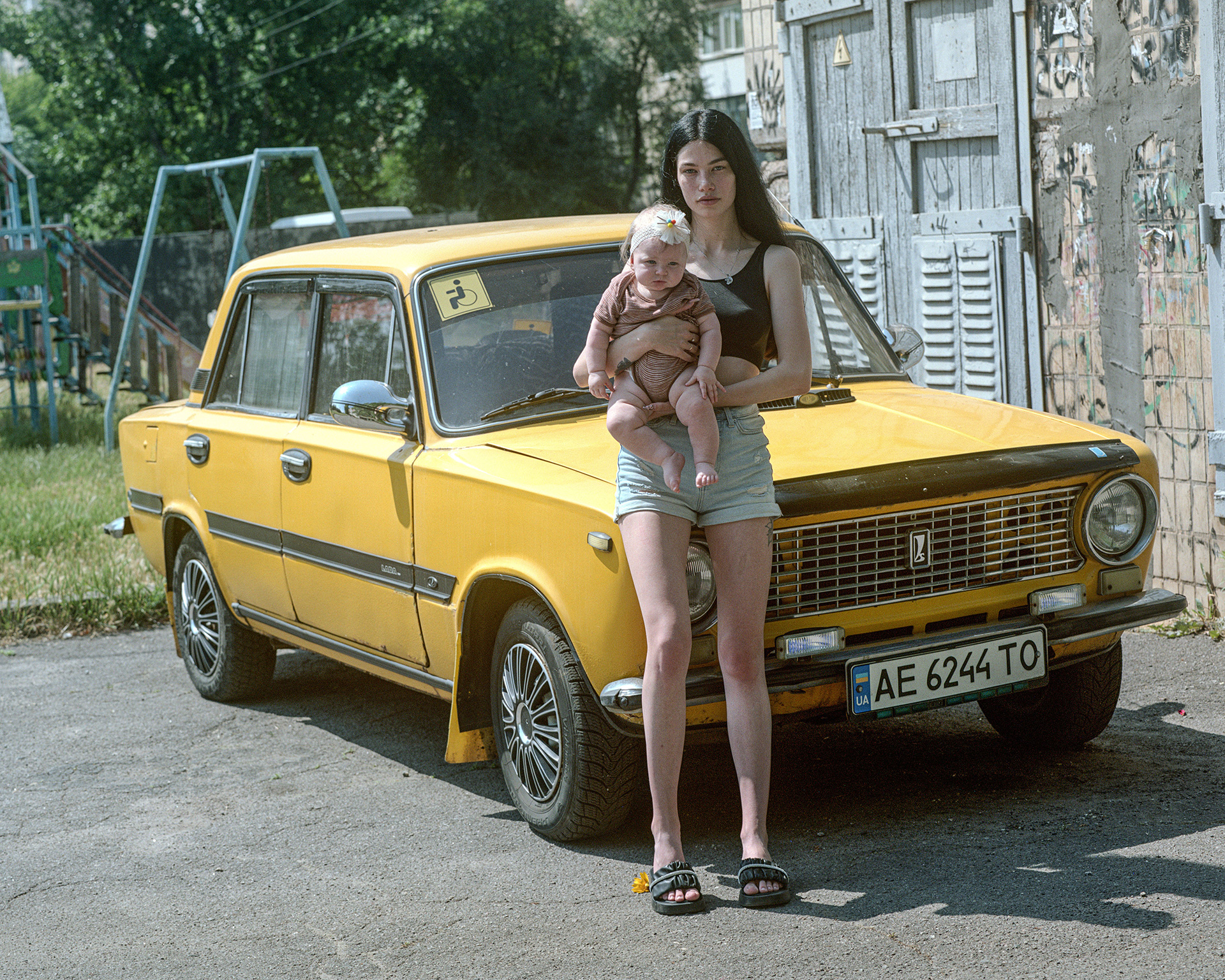
The photograph of a young mother holding her baby resonates on many levels. The scene looks like it could have been taken in a different era; the yellow car she rests on is dated and is likely older than the mother herself. The colour of the car - along with its design - suggests the harvest gold of the 1970s - abundance, joy and sunshine. But this is not a sunny scene. In the car window we notice the yellow disability sticker. Yellow is the colour of warnings and hazards.
Motherhood in times of conflict is shaped by conditions few parents should ever have to face. Yet millions of mothers around the world live through conflict; they offer and provide care and comfort for children through uncertainty, displacement, and the constant threat of violence and lifelong trauma. The photograph by Mark Neville reminds us that mothers' caregiving is constant and complex, and plays a vital role in keeping children supported and hopeful for the future.
Diary of a Volunteer is both an exhibition and a fundraising project.
Postcode Ukraine is a Kyiv-based charity founded in 2022 to support grassroots humanitarian organisations and volunteer groups working directly with communities affected by the war
*US supporters of Postcode Ukraine can make tax-deductible donations through our US partner, Shield of Freedom, a registered 501(c)(3) nonprofit supporting Ukraine. Donations made through this campaign are received and acknowledged by Shield of Freedom and, through its grant programme, support Postcode Ukraine's humanitarian aid initiatives in Ukraine.
Since 2022, Postcode Ukraine has directly funded more than $500,000 of humanitarian aid projects across Ukraine
Through photography, film and humanitarian action, Postcode Ukraine works to ensure that the experiences of ordinary Ukrainians are seen, remembered and supported.